Modern food factories face increasing pressure to improve freezing efficiency, food safety, and production consistency. As production volumes grow and regulations become stricter, traditional static freezers often fail to meet industrial requirements.
This is where a tunnel blast freezer — also known as an industrial blast chiller — becomes a critical part of a food factory blast freezing system.
This article explains how tunnel blast freezers work, why they are used in professional food processing environments, and how to select the right configuration based on production scale.
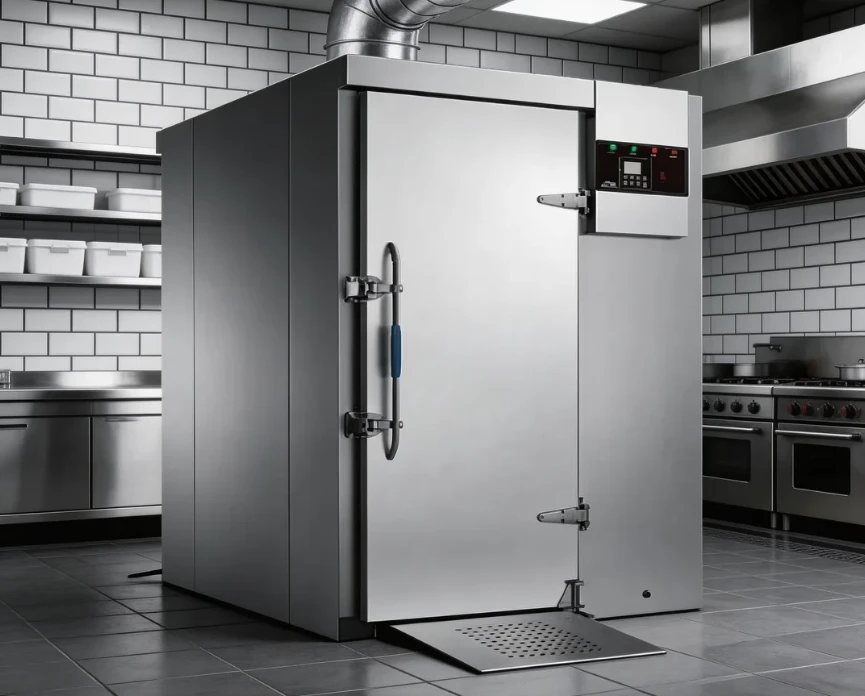
What Is a Tunnel Blast Freezer?
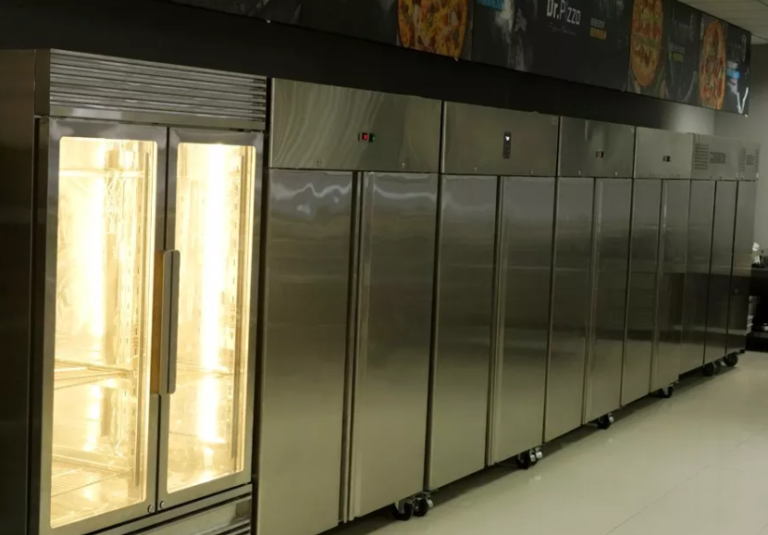
A tunnel blast freezer is an industrial freezing system designed with a linear channel structure. Products move through the freezer on trolleys, allowing:
- Strict separation between processing area and packaging area
- Controlled airflow direction
- Uniform freezing across all trays
Compared with cabinet-type blast freezers, tunnel systems are better suited for continuous or semi-continuous production lines in food factories.
Why Food Factories Use Tunnel-Type Blast Freezing Systems
From real production experience, tunnel blast freezing offers several operational advantages:
1. Compliance with Food Factory Workflow Design
Tunnel layouts align with food plant zoning principles:
- Raw processing → freezing → internal packaging
- Reduced cross-contamination risk
- Easier HACCP implementation
2. Higher Freezing Efficiency
High-speed airflow combined with strong refrigeration capacity allows:
- +90 °C to +3 °C chilling in 90 minutes
- +90 °C to −18 °C freezing in 240 minutes
This helps preserve texture, moisture, and nutritional value.
3. Scalable Production Capacity
Tunnel systems can be configured from:
- 100 kg/hour for small factories
- Up to 500 kg/hour for industrial lines
BL-TDE Series Tunnel Blast Freezer Overview
The BL-TDE series is designed specifically for food factories requiring reliable, scalable, and hygienic blast freezing solutions.
All models share common design principles:
- Channel-type tunnel structure
- SUS304 stainless steel interior & exterior
- Minimum operating temperature: −40 °C
- Support for both blast chilling and blast freezing
- Automatic defrost system
Product Comparison Table – Choose the Right Tunnel Blast Freezer
| Model | Trolley Capacity | Cooling Capacity | Typical Throughput | Best For |
|---|---|---|---|---|
| BL-TDE40T1 | 40 trays (1 trolley) | 12 kW | 100–150 kg/h | Small food factories, pilot lines |
| BL-TDE80T2 | 80 trays (2 trolleys) | 24 kW | 150–250 kg/h | Medium-scale production |
| BL-TDE120T3 | 120 trays (3 trolleys) | 36 kW | 250–400 kg/h | Industrial food plants |
| BL-TDE160T4 | 160 trays (4 trolleys) | 48–56 kW | 400–500 kg/h | High-volume frozen food factories |
Key Technical Specifications
| Parameter | Specification |
|---|---|
| Minimum Temperature | −40 °C |
| Blast Chilling | +90 °C → +3 °C in 90 min |
| Blast Freezing | +90 °C → −18 °C in 240 min |
| Refrigerant | R404A / R448 |
| Voltage | 3P 380V 50Hz |
| Insulation | 100 mm, 53 kg/m³ |
| Defrost Type | Automatic |
| Cooling Type | Air cooling / Water cooling |
| Condenser | Remote condenser option |
| Drainage | Gravity drainage |
Typical Applications of Industrial Blast Chillers
Tunnel blast freezers are widely used in:
- Quick-frozen pasta and noodles
- Frozen bakery and pastry products
- Livestock and poultry processing
- Prepared meals and central kitchens
- Frozen meat and protein processing
- High-volume frozen food export plants
How to Select the Right Tunnel Blast Freezer
From an engineering and production standpoint, buyers should focus on:
- Hourly freezing capacity (kg/h, not just tray count)
- Factory layout compatibility (length, trolley flow direction)
- Energy efficiency & refrigerant choice
- Maintenance access and cleaning design
- Future production scalability
Choosing a tunnel blast freezer is not just about freezing speed — it is about long-term operational stability.
Frequently Asked Questions (FAQ)
What is the difference between a tunnel blast freezer and a cabinet blast freezer?
Tunnel blast freezers are designed for workflow separation and higher throughput, while cabinet freezers are better for batch processing and small volumes.
Is a tunnel blast freezer suitable for prepared meals?
Yes. Tunnel blast freezing is ideal for prepared dishes because it ensures uniform freezing, helping maintain texture and taste.
What freezing capacity should a food factory choose?
Small factories typically start at 100–150 kg/h, while industrial plants often require 300–500 kg/h depending on daily output.
Can tunnel blast freezers support both chilling and freezing?
Yes. Industrial tunnel blast chillers are designed to handle both blast chilling and blast freezing within the same system.
What materials are used for food safety?
SUS304 stainless steel is commonly used for all food-contact and internal surfaces to meet hygiene standards.