The Restaurant Industry’s “Regret Medicine”:
How Blast Freezing Saves Your Food Cost and Protects Premium Ingredients
In professional kitchens, food waste is not just a sustainability issue—it is a direct attack on profit margins. High-value ingredients like Wagyu beef, king prawns, and fresh truffles often suffer from:
- Excessive spoilage
- Juice loss after thawing
- Texture degradation
- Inconsistent flavor performance
The solution is not “better storage.” The solution is correct freezing technology.
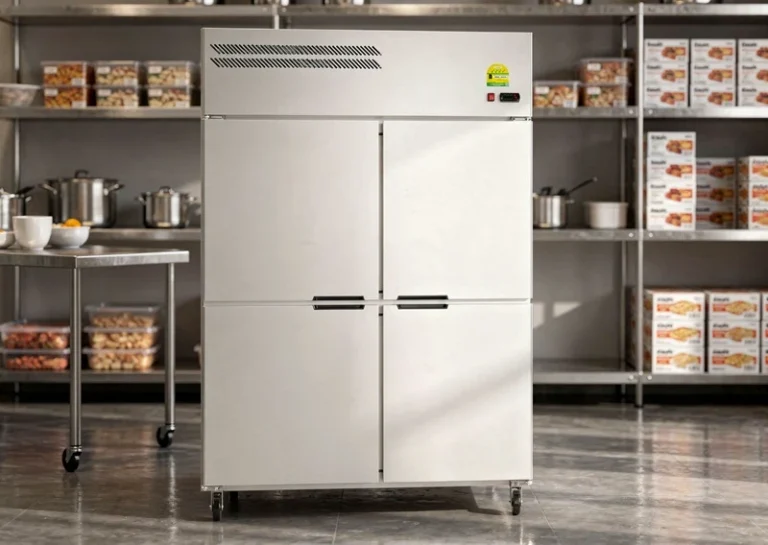
A blast freezer does not simply freeze food — it freezes time.
This article explains, from a scientific and operational perspective, why commercial blast freezers outperform conventional freezers, how they reduce ingredient loss, and how restaurants can restructure prep workflows to maximize ROI.
1. The Science: Why Standard Freezers Cause Damage
Slow Freezing vs. Rapid Freezing
A conventional freezer operates with gradual temperature reduction. This creates large ice crystals inside food tissues.
Large ice crystals:
- Rupture cell membranes
- Destroy muscle fiber structure
- Cause severe drip loss during thawing
- Lead to dry, oxidized texture
By contrast, a commercial blast freezer rapidly lowers food core temperature, typically moving through the critical ice crystal formation zone (0°C to -5°C) in under 30 minutes.
Why “30 Minutes” Matters
In food science, the most critical range is between 0°C and -5°C, where ice crystals form.
- Slow freezing → Large, damaging ice crystals
- Rapid freezing (≤30 minutes through this zone) → Micro-crystals
Micro-crystals:
- Preserve cell integrity
- Reduce thaw drip
- Maintain texture elasticity
- Protect flavor compounds
This is why blast freezing is widely used in professional food processing and Michelin-level kitchens.
2. The Economic Case: Calculating Real Loss Reduction
Let’s quantify the impact using conservative industry assumptions.
Case 1: Wagyu Beef
- Average purchase price: $80–$150 per kg
- Standard freezer drip loss: 8–12%
- Blast freezer drip loss: 2–4%
Example (100 kg/month usage):
| Item | Standard Freezer | Blast Freezer |
|---|---|---|
| Drip Loss | 10 kg | 3 kg |
| Monthly Loss (at $100/kg) | $1,000 | $300 |
| Monthly Savings | — | $700 |
Annualized savings: $8,400
Case 2: King Prawns
- High water content → sensitive to cell rupture
- Standard freezer shrinkage: 10–15%
- Blast freezer shrinkage: 3–5%
At 200 kg/month, $25/kg:
Potential savings: $1,000–$1,500 annually
Case 3: Fresh Truffles / Seasonal Mushrooms
These ingredients are:
- Moisture-sensitive
- Aromatic-compound fragile
- High spoilage risk
Blast freezing dramatically extends usable shelf life while preserving volatile compounds.
For premium restaurants, the ROI period of a blast freezer is often 6–12 months, depending on volume and ingredient profile.
3. Operational Advantage: Redesigning Kitchen Workflow
The Peak-Hour Problem
Most restaurants struggle with:
- Labor overload during service
- Inconsistent plating
- Delays caused by last-minute prep
The 80% Prep Strategy
With a blast freezer, chefs can:
- Complete 80% of preparation during non-peak hours
- Rapid-freeze pre-portioned proteins and semi-finished components
- Store in stable condition without quality compromise
- Thaw under controlled refrigeration before service
This enables:
- Reduced labor stress
- Faster ticket times
- Higher consistency
- Reduced emergency purchasing
Instead of reacting to demand, the kitchen becomes predictive and controlled.
4. Experience & Industry Insight
In high-performance kitchens, freezing is not a storage method—it is a production tool.
Professional food manufacturers have used blast freezing for decades because:
- It stabilizes product quality
- It reduces batch variability
- It protects margin
Restaurants adopting the same approach gain a structural advantage over competitors still relying on slow-freezing systems.
5. Why Equipment Design Matters
Not all blast freezers are equal. Critical parameters include:
- Airflow velocity (high-speed air circulation)
- Evaporator efficiency
- Compressor capacity
- Temperature uniformity
- Stainless steel hygiene design
- HACCP compliance
Selecting the correct equipment size based on daily throughput is essential for achieving true ≤30-minute ice-zone transition.
Frequently Asked Questions (FAQ)
1. Is blast freezing the same as deep freezing?
No. Deep freezing refers to low temperature storage. Blast freezing refers to rapid temperature reduction, especially through the ice crystal formation zone.
2. Will blast freezing change the taste?
Proper blast freezing preserves flavor better than slow freezing because it prevents structural damage and oxidation.
3. How long does blast-frozen food last?
Shelf life depends on ingredient type, but quality retention is significantly longer compared to conventional freezing.
4. Is blast freezing only for large factories?
No. Modern commercial blast freezers are available in compact formats suitable for restaurants, hotels, bakeries, and central kitchens.
5. What is the ROI period?
For restaurants using high-value proteins, ROI typically ranges from 6 to 12 months.
Why Partner with Realmann?
Realmann is a professional manufacturer specializing in commercial refrigeration and blast freezing equipment.
We provide:
- Commercial blast chillers & freezers
- Energy-efficient refrigeration systems
- OEM/ODM customization
- HACCP-oriented design
- Global distribution support
Whether you operate a restaurant, central kitchen, bakery, or food processing facility, Realmann delivers scalable freezing solutions tailored to your production workflow.
We are actively recruiting global distributors and strategic partners.
Ready to reduce food waste and increase kitchen efficiency?
Contact Realmann today for technical consultation, OEM/ODM solutions, or global dealership inquiries.
Upgrade your freezing system — and freeze time in your favor.