Blast Chillers in Commercial Kitchens: Optional Luxury or Food Safety Essential?
In the commercial food and catering industry, the blast chiller (fast freezer) is a frequent topic of debate. Commercial-grade flash-freezing equipment represents a serious investment, leading many operators to ask: Is a blast chiller an indispensable hardware requirement for food safety and quality, or just an optional upgrade?
This guide breaks down the science of flash freezing, its critical role in HACCP food safety compliance, and how to determine the ROI for your business.
1. The Science: Blast Freezers vs. Standard Commercial Freezers
The primary difference between a standard freezer and a professional blast chiller lies in freezing speed and ice crystal formation.
| Feature | Standard Commercial Freezer | Professional Blast Chiller |
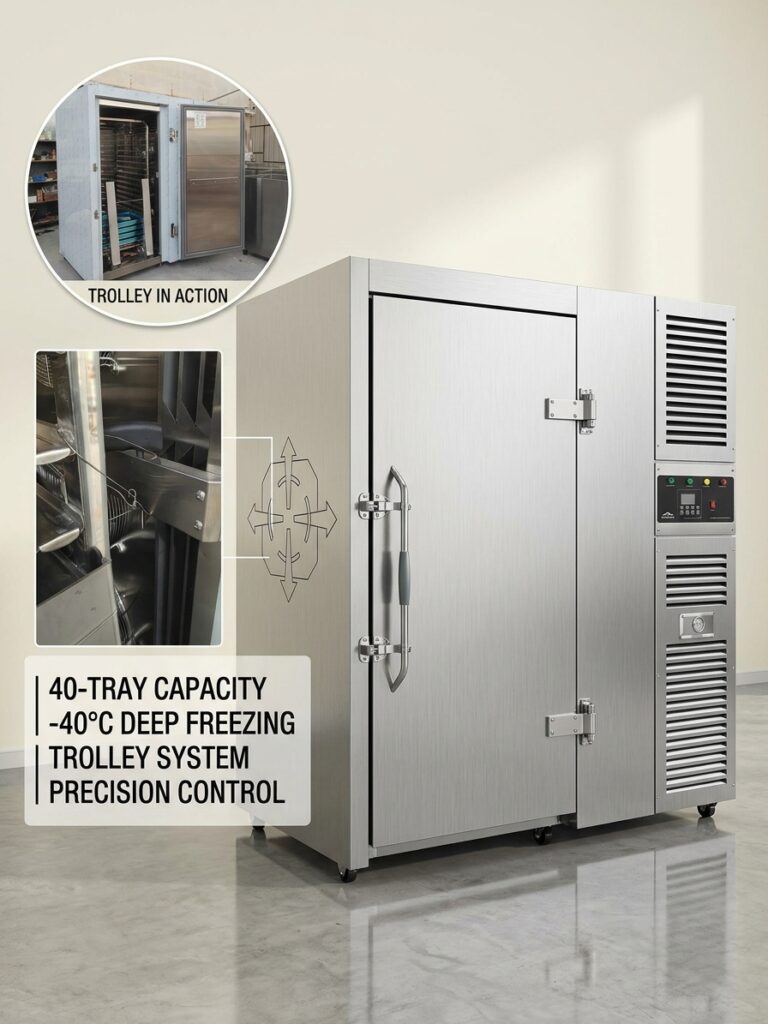
| Cooling Speed | Slow reduction (takes hours or overnight) | Ultra-fast airflow (drops core temp to -18°C / -40°C in minutes) |
| Ice Crystal Size | Forms large, jagged ice crystals | Forms microscopic, uniform ice crystals |
| Cellular Impact | Ruptures cell walls; severe drip loss and dryness upon thawing | Preserves cellular structure; zero loss of moisture and texture |
| Quality Retention | Degrades texture, flavor, and visual appeal | Retains up to 98% of fresh-cooked texture and color |
2. Food Safety: Cutting Off the Bacterial Danger Zone
Temperature control is the absolute baseline of food safety and HACCP compliance. Blast chillers provide vital protection against foodborne pathogens:
- Bypassing the “Danger Zone” Immediately: Bacteria like Salmonella, E. coli, and Staphylococcus multiply exponentially between 4°C and 60°C (40°F–140°F). Standard freezers cool hot food slowly, leaving items in this danger zone for too long. Blast chillers force foods through this critical range in minutes.
- Preventing Chemical Degradation: Rapid sub-zero freezing halts enzymatic oxidation, preventing color fading, off-flavors, and rancidity without needing artificial preservatives.
- Compliant Prep-Ahead Cooling: Modern central kitchens and catering facilities preparing large batches of soups, sauces, or pre-cooked proteins are legally required to chill hot food within strict time limits—making blast chillers an operational necessity.
3. Decision Matrix: Essential or Optional for Your Kitchen?
Essential (Must-Have):
- High-End Seafood & Steakhouse Operations: Drip-loss directly damages high-margin ingredients. Flash freezing preserves premium texture.
- Bakeries & Pastry Shops: Mousse, artisan pastries, and frozen dough require blast freezing for structural integrity and delicate layering.
- Central Kitchens & Meal-Prep Brands: Essential for batch cooking, cook-chill workflows, and food safety compliance during distribution.
Optional (Nice-to-Have):
- Small Fast-Casual Diners: High daily inventory turnover with minimal overnight storage or advance prep needs.
- Beverage & Fresh Fruit Bars: Standard commercial refrigeration is generally sufficient for short-term preservation.
Frequently Asked Questions (FAQ)
Q1: Does the high-velocity air in a blast chiller dry out the food? A: No. Blast chillers quickly freeze the moisture on the food’s surface, forming a protective micro-ice shield that actually seals in internal juices far better than slow cooling in a standard freezer.
Q2: How does a blast chiller pay for itself? A: Blast chillers reduce food waste from spoilage, allow kitchens to prep in bulk during off-peak hours (saving labor costs), and enable seasonal bulk-purchasing of raw ingredients at lower prices. Most commercial kitchens recoup the cost within 6 to 12 months.