Static Cooling vs. Frost-Free Commercial Freezers: Precision Temperature Control and Food Safety Guide
Maintaining stable freezing temperatures is essential for preserving the quality, texture, and shelf life of frozen foods. For commercial applications such as ice cream retail, seafood storage, supermarkets, and professional kitchens, even temporary temperature fluctuations can affect product quality and increase operational risks.
A commercial freezer does more than keep food frozen. It must maintain appropriate storage conditions despite frequent door openings, changing ambient temperatures, and continuous daily operation.
Two commonly used refrigeration methods are static cooling (direct cooling) and air-cooled frost-free refrigeration (forced-air cooling).
Both technologies can provide reliable frozen storage, but their operating mechanisms, temperature distribution, defrost requirements, and suitability for different products vary.
For commercial refrigeration buyers, choosing between static and frost-free freezers requires evaluating several factors:
- Temperature stability and uniformity
- Cooling recovery after door openings
- Frost formation and defrost management
- Ice cream and frozen seafood storage requirements
- Product dehydration and packaging protection
- Energy consumption and maintenance costs
- Daily operating conditions
As a professional commercial freezer manufacturer, Realmann offers static-cooled display freezers and air-cooled commercial refrigeration solutions for different food storage applications.
This guide explains how both cooling systems work, how precise temperature control helps protect frozen food quality, and which technology is most suitable for your business.
1. Why Precision Temperature Control Matters in Commercial Freezers
Temperature stability is one of the most important factors affecting frozen food quality.
Frozen products are sensitive not only to storage temperatures but also to repeated temperature fluctuations during transportation, loading, retail display, and daily operation.
Although freezing slows microbial activity and helps preserve food, it does not eliminate all microorganisms or prevent every form of quality deterioration.
Maintaining a consistent frozen storage temperature is therefore essential for preserving product quality and supporting proper food safety management.
What Is the Recommended Commercial Freezer Temperature?
For many categories of frozen foods, -18°C (0°F) or below is a widely used storage benchmark.
However, the appropriate temperature depends on the specific food product, packaging, intended storage period, and applicable regulations.
| Frozen Product | Typical Storage Target | Main Quality Consideration |
|---|---|---|
| Packaged Ice Cream | -18°C or colder; some products benefit from -20°C to -25°C | Texture and ice crystal stability |
| Frozen Seafood | -18°C or colder | Texture, moisture retention and oxidation |
| Frozen Meat | -18°C or colder | Frozen storage quality |
| Frozen Vegetables | -18°C or colder | Texture, color and nutritional quality |
| Frozen Ready Meals | -18°C or colder | Product stability and shelf life |
| Frozen Bakery Products | Usually -18°C or colder | Moisture retention and product texture |
These temperatures are general storage references, not universal legal requirements. Always follow product-specific storage instructions and local food safety regulations.
Commercial freezer applications that require a maintained cabinet temperature between -22°C and -18°C are common in professional frozen food storage.
For particularly temperature-sensitive products, operators may select colder temperature settings to provide additional protection against temperature fluctuations.
What Happens When Freezer Temperatures Fluctuate?
Repeated temperature changes can affect frozen food in several ways.
Ice Crystal Growth
When frozen products experience temperature fluctuations, small ice crystals may partially melt and recrystallize into larger structures.
This process can damage food texture, particularly in ice cream and frozen seafood.
Moisture Migration
Temperature changes can encourage moisture movement between the frozen product, its packaging, and surrounding air.
This may contribute to dehydration, frost accumulation, and freezer burn.
Texture Deterioration
Ice cream may develop a coarse or icy texture, while seafood can lose some of its original firmness and juiciness.
Reduced Product Quality
Repeated fluctuations can negatively affect flavor, appearance, and sensory quality.
Food Safety Concerns
Significant or prolonged temperature excursions can create food safety risks, particularly when products partially thaw or are exposed to unsafe temperatures.
For these reasons, commercial refrigeration systems should be selected based on their ability to maintain suitable product temperatures under realistic operating conditions.
2. What Is Static Cooling in a Commercial Freezer?
Static cooling, also known as direct cooling, is a refrigeration method that removes heat through refrigerated surfaces without relying on a fan to circulate cabinet air.
In a typical static-cooled chest freezer, refrigerant flows through evaporator tubing integrated into or positioned near the cabinet walls.
Heat transfers from the stored products and interior air toward these cold surfaces.
Natural convection and thermal conduction help distribute cooling throughout the storage compartment.
How Static Cooling Works
The basic cooling process involves four stages:
- The compressor circulates refrigerant through the refrigeration system.
- Refrigerant absorbs heat at the evaporator.
- The cabinet walls or cooling surfaces become cold.
- Heat moves from the stored products and interior air toward the refrigerated surfaces.
Because most static cooling systems do not use an internal circulation fan, air movement is relatively limited.
This creates a different temperature distribution and cooling recovery pattern compared with forced-air refrigeration.
Key Advantages of Static Cooling Freezers
1. Simple Refrigeration Structure
Static cooling systems generally have fewer air circulation components inside the cabinet.
This can simplify the equipment design and reduce the number of components requiring routine maintenance.
2. Reduced Forced-Air Exposure
Without continuous fan-driven airflow, unpackaged or loosely packaged products may experience less air movement across exposed surfaces.
This can help limit airflow-related dehydration, although appropriate packaging remains essential.
3. Suitable for Horizontal Chest Freezers
Static cooling works particularly well in many horizontal commercial freezer designs.
Because cold air is denser than warm air, a top-opening chest freezer can retain much of its cold air during brief lid openings, depending on surrounding conditions.
4. Practical Frozen Food Storage
Direct cooling is widely used in commercial chest freezers, island display freezers, and packaged frozen food storage applications.
5. Potentially Lower System Complexity
Static cooling equipment may avoid the additional fans and associated controls required by forced-air systems.
However, actual energy efficiency depends on the complete refrigeration design, insulation, and operating conditions.
Limitations of Static Cooling
Less Uniform Air Temperature
Because the system relies heavily on natural convection, temperature differences may occur between cabinet locations.
Slower Air Temperature Equalization
After warm air enters the cabinet, temperature distribution may recover more slowly than in a well-designed forced-air system.
Frost Accumulation
Moisture entering the cabinet may freeze onto cold surfaces.
Many static freezers require periodic manual defrosting.
Storage Arrangement Matters
Overloading or incorrectly arranging frozen products can influence temperature distribution and access.
Best Applications for Static Cooling Freezers
- Commercial chest freezers
- Supermarket island display freezers
- Packaged ice cream storage
- Frozen seafood merchandising
- Frozen meat storage
- Packaged frozen vegetables
- Convenience store frozen food displays
For retailers seeking a practical frozen storage solution with relatively simple refrigeration construction, static cooling is often a suitable option.
3. What Is Air-Cooled Frost-Free Refrigeration?
An air-cooled commercial freezer, also called a forced-air or fan-assisted freezer, uses fans to circulate refrigerated air throughout the cabinet.
Instead of relying primarily on natural convection, the refrigeration system actively distributes cold air from the evaporator into the storage compartment.
In frost-free configurations, an automatic defrost system periodically removes frost from the evaporator.
This helps maintain airflow and refrigeration performance without requiring routine manual evaporator defrosting.
How Air-Cooled Freezers Work
A typical forced-air freezer operates through the following process:
- The compressor circulates refrigerant through the evaporator.
- Heat is absorbed from the air passing across the evaporator.
- Fans distribute cooled air through the cabinet.
- Return air flows back toward the evaporator.
- A temperature controller adjusts refrigeration operation according to sensor measurements.
Where automatic defrost is included, the system also removes accumulated evaporator frost at controlled intervals.
Key Advantages of Air-Cooled Frost-Free Freezers
1. More Uniform Temperature Distribution
Forced-air circulation helps reduce temperature differences between cabinet locations.
This is especially valuable in tall, multi-shelf commercial freezers.
2. Faster Cabinet Air Temperature Recovery
After a door is closed, active air circulation helps redistribute cold air throughout the compartment.
A properly sized forced-air system can recover cabinet air temperature quickly, although actual recovery depends on refrigeration capacity and thermal load.
3. Automatic Evaporator Defrost
Frost-free systems use automatic defrost technology to manage frost accumulation on the evaporator.
This reduces the need for manual evaporator defrosting.
4. Suitable for High-Frequency Access
Forced-air systems are commonly used in busy professional kitchens, restaurants, hotels, and food service operations.
5. Effective Multi-Shelf Refrigeration
Air ducts and fans support cold air distribution across multiple shelf levels.
This makes forced-air refrigeration particularly useful in upright reach-in freezers.
Limitations of Air-Cooled Freezers
Additional Electrical Components
Fans, defrost heaters or other defrost devices, and electronic controls introduce additional electrical loads and components.
Potential Product Dehydration
Continuous airflow can increase moisture loss from exposed food surfaces.
Proper packaging and storage containers are important.
Defrost Temperature Changes
During automatic defrost, evaporator temperatures rise temporarily.
A properly designed system controls defrost duration and protects stored product temperatures, but poor configuration can cause undesirable temperature excursions.
Airflow Clearance Requirements
Blocking air supply or return openings can reduce cooling effectiveness.
Best Applications for Air-Cooled Freezers
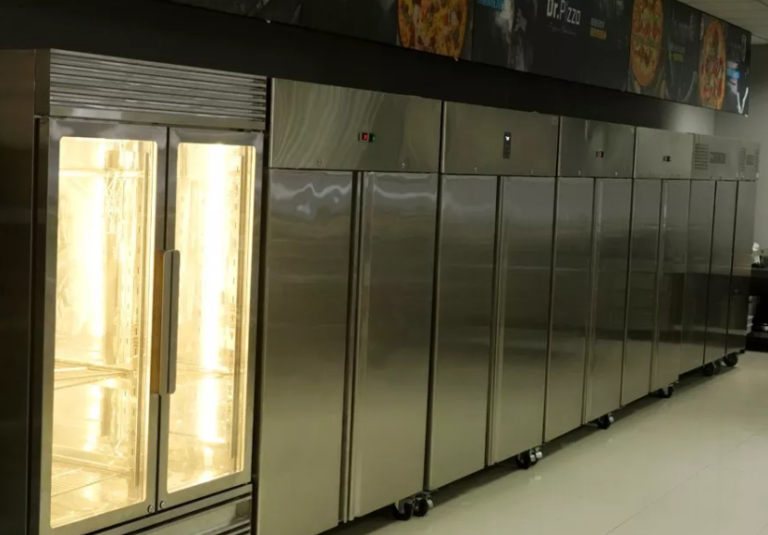
- Commercial upright reach-in freezers
- Restaurant kitchens
- Hotels and catering operations
- Frozen food preparation facilities
- Multi-shelf frozen storage
- High-access commercial food storage
- Professional kitchen worktop freezers
Air-cooled systems are particularly attractive when temperature uniformity, convenient access, and automatic frost management are operational priorities.
4. Static Cooling vs. Frost-Free Freezers: Key Differences
The following comparison explains the major technical and operational differences between static cooling and air-cooled frost-free refrigeration.
| Feature | Static Cooling Freezer | Air-Cooled Frost-Free Freezer |
|---|---|---|
| Cooling Method | Natural convection and cooled surfaces | Forced-air circulation |
| Internal Fan | Usually not required | Required |
| Temperature Uniformity | More location-dependent | Generally more uniform |
| Air Temperature Recovery | Depends on cabinet design and cooling load | Often faster with suitable airflow |
| Frost Management | Often manual defrost | Automatic evaporator defrost |
| Product Dehydration | Lower forced-air exposure | Greater risk for uncovered products |
| Refrigeration Structure | Relatively simple | More components and controls |
| Maintenance | May require manual defrost | Requires fan and defrost system maintenance |
| Energy Consumption | Design-dependent | Design-dependent |
| Typical Cabinet Style | Chest and island freezers | Upright and worktop freezers |
| Suitable Products | Packaged frozen foods and ice cream | Packaged frozen foods, meats and ingredients |
| Main Advantage | Practical frozen storage | Air distribution and frost management |
Key Takeaway: Static cooling is well suited to many chest and island freezer applications, while forced-air frost-free refrigeration is often better suited to multi-shelf upright cabinets and frequently accessed commercial kitchens.
Neither technology is universally superior. Equipment selection should depend on the complete cabinet design and intended operating conditions.
5. Which Cooling System Is Better for Ice Cream Storage?
Ice cream is particularly sensitive to repeated temperature fluctuations because its texture depends on the stability of ice crystals, air cells, and the frozen mixture.
Maintaining appropriate storage temperatures is essential for preserving a smooth texture and consistent product quality.
Why Ice Cream Requires Stable Freezing Temperatures
When ice cream warms, some ice crystals may partially melt.
When the product cools again, water can recrystallize onto existing crystals, causing them to grow.
Repeated fluctuations can produce a coarse, grainy texture.
This quality deterioration may occur even when the product does not completely thaw.
For many packaged ice cream products, storage at -18°C or colder is appropriate, while some manufacturers recommend approximately -20°C to -25°C for quality preservation.
Always follow the product supplier’s storage requirements.
Static Cooling for Packaged Ice Cream
Static-cooled chest freezers are commonly used for packaged ice cream.
Their horizontal cabinet structure and top-opening lids can help limit the exchange of cold cabinet air with surrounding warm air during brief openings.
This makes them suitable for:
- Ice cream bars
- Packaged cones
- Frozen dessert tubs
- Ice cream multipacks
- Supermarket ice cream merchandising
In these applications, static cooling can provide dependable storage when the freezer is correctly sized, maintained, and operated.
Air-Cooled Freezers for Ice Cream Storage
Air-cooled freezer systems can also maintain suitable ice cream storage temperatures.
They may be useful in multi-shelf frozen storage facilities and professional operations where uniform air temperatures are important.
However, exposed products should be protected against dehydration caused by continuous airflow.
Which Is the Better Choice?
For packaged ice cream sold through horizontal display cabinets, static cooling is often a practical choice.
For multi-shelf storage rooms, upright freezers, or applications requiring active air circulation, forced-air cooling may be more appropriate.
The most important factor is not the cooling technology alone but the actual stability of the product temperature.
6. Which Cooling System Is Better for Frozen Seafood?
Frozen seafood is highly sensitive to improper temperature management.
Temperature fluctuations can contribute to changes in texture, moisture retention, appearance, and overall product quality.
For commercial seafood retailers and distributors, choosing suitable freezer equipment is an important part of maintaining frozen storage conditions.
Why Seafood Temperature Stability Matters
Frozen fish and seafood contain significant amounts of water.
When storage temperatures fluctuate, changes in ice crystal structure and moisture distribution can affect the quality of the product.
Potential problems include:
- Moisture loss
- Surface dehydration
- Freezer burn
- Texture deterioration
- Undesirable frost accumulation
- Oxidative quality changes
For many frozen seafood products, maintaining temperatures at -18°C or colder is a common storage requirement.
Certain seafood products, specialized frozen storage applications, or extended storage programs may require lower temperatures.
Static Cooling for Frozen Seafood Displays
Static-cooled seafood chest freezers are suitable for packaged frozen fish, shrimp, shellfish, and other seafood products.
The enclosed horizontal cabinet design allows retailers to organize merchandise in storage compartments or baskets.
Glass-top and high-front-glass designs can also support customer-facing seafood merchandising.
Air-Cooled Systems for Commercial Seafood Storage
Forced-air freezers may be suitable for professional kitchens, seafood preparation facilities, and packaged frozen seafood storage.
Their active air circulation can help distribute cold air throughout multi-shelf cabinets.
However, unpackaged seafood should not be continuously exposed to strong airflow without appropriate protection.
Sealed packaging and suitable storage containers help limit dehydration.
Important: Storage Freezers Are Not Blast Freezers
Commercial storage freezers are intended primarily to maintain products that are already frozen.
They should not automatically be used to rapidly freeze large quantities of fresh seafood.
Rapid freezing generally requires appropriately designed blast freezing equipment with sufficient refrigeration capacity and airflow.
For seafood processing operations, the initial freezing stage and subsequent frozen storage stage should be evaluated separately.
7. How Frequent Door Openings Affect Freezer Temperature Stability
Frequent door openings are among the most common challenges in commercial freezer operation.
In supermarkets, restaurants, and convenience stores, freezer doors may be opened repeatedly during product selection, stock replenishment, and food preparation.
Each opening creates an opportunity for heat and moisture to enter the cabinet.
What Happens When a Freezer Door Opens?
When a freezer door opens, relatively warm air from the surrounding environment enters the refrigerated compartment.
The resulting effects depend on cabinet geometry, door size, opening duration, and environmental conditions.
Common consequences include:
Warm Air Infiltration
Ambient air introduces an additional thermal load into the freezer.
Cabinet Air Temperature Increase
The air temperature may rise temporarily, especially near the door opening.
Moisture Entry
Humidity entering the cabinet can freeze on cold surfaces and contribute to frost formation.
Additional Compressor Operation
The refrigeration system may need to run longer to remove the additional heat.
Potential Product Temperature Changes
Repeated or prolonged openings can eventually affect product temperatures, particularly when merchandise is poorly positioned or insufficiently frozen.
Chest Freezers vs. Upright Freezers During Door Openings
Chest freezers and upright freezers respond differently to door openings because of their cabinet geometry.
Top-Opening Chest Freezers
A horizontal chest freezer may retain more of its cold air during a brief lid opening.
The top-opening arrangement can limit some direct cold air loss because dense cold air tends to remain within the cabinet.
Front-Opening Upright Freezers
When an upright freezer door opens, cold air can spill outward while warmer room air enters.
This can produce a noticeable change in cabinet air temperature.
However, airflow design, door opening duration, insulation, refrigeration capacity, and usage patterns all affect the final result.
A well-designed upright freezer may still provide excellent temperature stability under frequent commercial use.
8. How to Reduce Temperature Fluctuations After Door Openings
Reducing temperature fluctuations requires a combination of refrigeration design, proper operating procedures, and preventive maintenance.
1. Use Accurate Electronic Temperature Controllers
Modern electronic controllers monitor cabinet temperature and adjust compressor operation according to programmed settings.
Compared with simple mechanical control systems, appropriately configured electronic controllers can provide more precise setpoint adjustment and additional monitoring functions.
Important parameters include:
- Temperature setpoint
- Temperature differential or hysteresis
- Sensor position
- Compressor start and stop logic
- Defrost control
- High-temperature alarm thresholds
A controller’s accuracy should be evaluated together with sensor accuracy and the complete refrigeration system.
2. Optimize Airflow Distribution
For forced-air freezers, unobstructed air circulation is essential.
Air ducts, evaporator fans, and return-air openings should be designed to distribute cold air throughout the storage compartment.
Operators should avoid blocking airflow with cartons or containers.
3. Select Adequate Refrigeration Capacity
An undersized refrigeration system may struggle to recover temperature after repeated door openings or heavy loading.
Commercial buyers should consider:
- Ambient operating temperature
- Required storage temperature
- Door opening frequency
- Product loading volume
- Cabinet size
- Insulation performance
Refrigeration capacity should be selected according to the actual application rather than cabinet volume alone.
4. Improve Door Sealing
Damaged or poorly fitted door gaskets can allow continuous infiltration of warm, humid air.
Routine inspection and timely gasket replacement help maintain freezing performance.
5. Minimize Door Opening Duration
Staff should organize products so frequently used items can be accessed quickly.
Reducing unnecessary door opening time limits heat and moisture infiltration.
6. Use Suitable Storage Containers and Baskets
Organized merchandise reduces the time required to locate products.
Appropriate packaging also protects food from direct airflow and dehydration.
7. Monitor Temperature Trends
Temperature monitoring systems can identify recurring fluctuations, extended door openings, and abnormal refrigeration performance.
For businesses operating multiple freezers, monitoring records can help identify problems before they affect large quantities of stored products.
9. Frost Management: Manual Defrost vs. Automatic Defrost
Frost forms when moisture freezes on surfaces below the freezing point.
In commercial freezers, moisture can enter through door openings, damaged seals, and newly loaded products.
Over time, frost accumulation may affect airflow, heat transfer, usable space, and refrigeration performance.
Manual Defrost in Static Cooling Freezers
Many static-cooled freezers require periodic manual defrosting.
As frost accumulates on the cold surfaces, operators may need to temporarily empty the cabinet, switch off refrigeration, and remove the ice buildup.
Advantages:
- Simple construction
- No dedicated automatic defrost heater in basic designs
- Relatively straightforward maintenance
Considerations:
- Requires planned maintenance
- Products must remain under appropriate frozen storage conditions during defrost
- Excessive frost can reduce operational efficiency
- Defrost frequency depends on humidity and usage
Automatic Defrost in Air-Cooled Freezers
Frost-free freezers typically use automatic evaporator defrost systems.
Common defrost methods include:
Electric Defrost
Heating elements periodically warm the evaporator to melt accumulated frost.
Hot-Gas Defrost
Hot refrigerant gas is directed through an appropriate circuit to remove evaporator frost.
Off-Cycle Defrost
The compressor stops while conditions allow frost to melt. This method is generally associated with above-freezing refrigeration applications and is not typically sufficient by itself for low-temperature freezer evaporators.
Does Automatic Defrost Affect Food Temperature?
During defrost, evaporator temperatures rise temporarily.
A properly designed commercial freezer manages this process by controlling defrost duration, fan operation, and refrigeration recovery.
Cabinet air temperature may fluctuate during a defrost cycle, but this does not necessarily mean that the stored food has experienced the same temperature increase.
Frozen products have thermal mass and typically change temperature more slowly than the surrounding air.
However, poor defrost design, excessive heating, or prolonged defrost periods can create unwanted product temperature fluctuations.
For food safety and product quality, manufacturers should validate defrost performance under representative operating conditions.
10. Precision Temperature Control: Important Technologies in Modern Commercial Freezers
Advanced commercial refrigeration systems use multiple technologies to help maintain suitable cabinet temperatures and manage operating loads.
Electronic Temperature Controllers
Digital temperature controllers allow operators to set target temperatures and monitor the system.
Depending on the controller, available functions may include alarms, defrost scheduling, and sensor diagnostics.
Inverter Compressors
Inverter-driven compressors can adjust their operating speed according to refrigeration demand.
Rather than relying only on fixed-speed operation, variable-speed systems can better match compressor capacity to changing cooling loads when properly designed.
This may improve temperature control and reduce energy consumption in suitable applications.
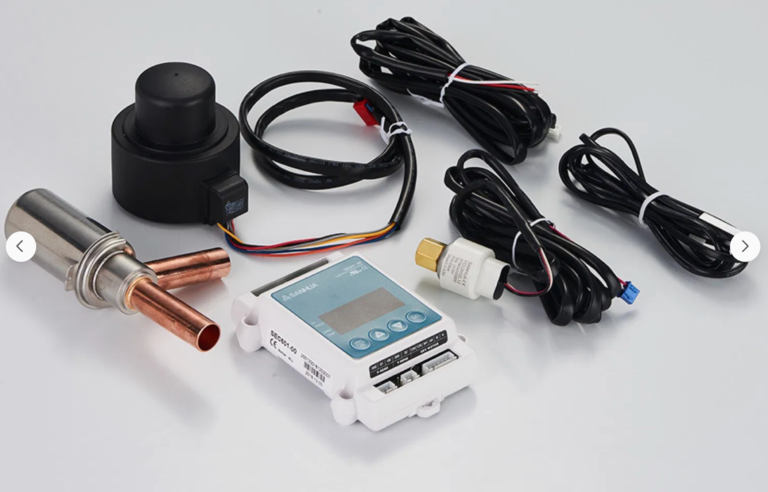
Electronic Expansion Valves
Electronic expansion valves regulate refrigerant flow through the refrigeration system.
When integrated with suitable sensors and control algorithms, they can support precise evaporator operation across changing load conditions.
EC Fans
Electronically commutated fans provide efficient air movement and can support variable-speed operation.
In forced-air freezers, EC fans can help manufacturers optimize airflow distribution and electrical consumption.
High-Performance Cabinet Insulation
Effective insulation reduces unwanted heat transfer through cabinet walls.
Commercial refrigeration designs may use polyurethane or cyclopentane-blown foam insulation, with additional advanced materials in selected applications.
Remote Monitoring and Data Logging
Monitoring systems can record cabinet temperature and operating conditions.
Some commercial refrigeration controllers also support communication interfaces such as RS485 and Modbus for integration into centralized monitoring systems.
These technologies can support HACCP-based temperature monitoring procedures where properly implemented and validated.
11. Realmann Commercial Freezer Solutions: Static Cooling and Air-Cooled Systems
Realmann manufactures commercial refrigeration equipment for supermarkets, food service businesses, ice cream retailers, seafood distributors, and professional kitchens.
Its product portfolio includes both static-cooled display freezers and forced-air commercial freezer systems, allowing buyers to select equipment according to storage conditions and operational requirements.
Realmann SD/SC-P Series: Static Cooling Island Display Freezer
The Realmann SD/SC-P Series Commercial Flat Glass Island Display Freezer is designed for supermarket frozen food merchandising.
The series uses direct cooling technology to maintain frozen storage conditions.
Key features include:
- Static/direct cooling refrigeration
- Rated storage temperature of -18°C or below
- Low-E coated tempered glass lids
- Electronic digital temperature control
- Multiple cabinet capacity options
- Interior baskets for organized merchandise storage
- Reinforced cabinet construction
- Suitable design for packaged frozen foods
Recommended Applications:
Supermarkets, convenience stores, packaged ice cream merchandising, frozen seafood retail, and frozen ready-meal displays.
This series is particularly relevant for buyers seeking a practical horizontal display freezer using direct cooling technology.
Explore Realmann SD/SC-P Static Cooling Island Freezers
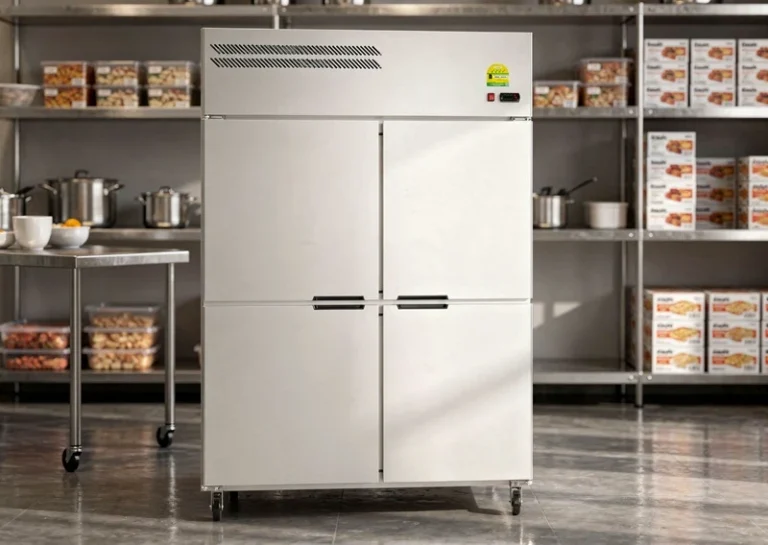
Realmann YHA-4F-E: Air-Cooled Commercial Upright Freezer
The Realmann YHA-4F-E Air-Cooled Four-Door Freezer is designed for professional frozen storage in commercial kitchens and food service environments.
Its forced-air refrigeration system supports cold air distribution across the cabinet.
Key features include:
- Forced-air cooling system
- Temperature range of -22°C to -18°C
- Approximately 940 L usable storage capacity
- Automatic electric defrost
- R290 refrigeration system
- 60 mm cyclopentane insulation
- Food-grade stainless steel interior
- Corrosion-resistant evaporator
- Removable front filter
- Optional RS485 Modbus communication
Recommended Applications:
Restaurants, hotels, catering facilities, commercial kitchens, food preparation areas, and professional frozen ingredient storage.
This model is suitable for businesses requiring multi-shelf upright frozen storage with automatic evaporator defrost management.
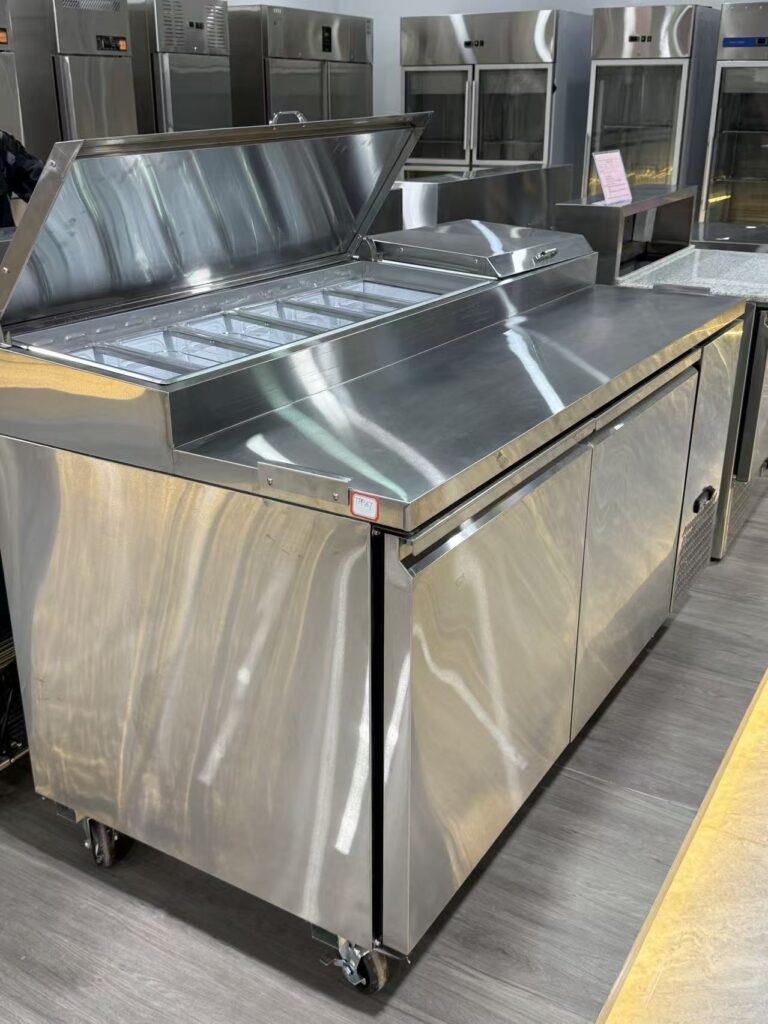
Realmann YTA-180F3-E: Air-Cooled Worktop Freezer
The Realmann YTA-180F3-E Commercial Worktop Freezer combines frozen food storage with a practical stainless steel worktop design.
It is intended for professional kitchens where storage access and food preparation efficiency are important.
Key features include:
- Forced-air refrigeration
- Operating temperature range of -22°C to -18°C
- Inverter-driven compressor
- R290 refrigeration system
- EC evaporator and condenser fans
- Duct-controlled airflow
- 60 mm insulation specification
- Stainless steel construction
- Front-access maintenance design
Recommended Applications:
Restaurant preparation areas, commercial kitchens, catering facilities, and food service operations requiring convenient undercounter frozen storage.
Explore Realmann 1800 Air-Cooled Worktop Freezer
Realmann Static vs. Air-Cooled Freezer Comparison
| Specification | SD/SC-P Island Freezer | YHA-4F-E Upright Freezer | YTA-180F3-E Worktop Freezer |
|---|---|---|---|
| Cooling Type | Static/direct cooling | Forced-air cooling | Forced-air cooling |
| Cabinet Design | Horizontal island | Four-door upright | Worktop |
| Storage Temperature | -18°C or below | -22°C to -18°C | -22°C to -18°C |
| Temperature Control | Electronic | Electronic control system | Electronic control system |
| Frost Management | Manual defrost may be required | Automatic electric defrost | Model-specific defrost configuration |
| Air Circulation | Natural convection | Forced-air circulation | Duct-controlled airflow |
| Primary Application | Frozen food retail | Professional frozen storage | Commercial food preparation |
| Product Access | Top-opening glass lids | Front-opening doors | Front-opening doors |
Specifications are based on the relevant Realmann product series. Please confirm the final configuration and operating characteristics before ordering.
12. How to Choose the Right Commercial Freezer for Different Foods
Commercial freezer selection should reflect the specific storage requirements of the products and the daily operating conditions.
| Application | Recommended Cooling Type | Main Reason |
|---|---|---|
| Packaged Ice Cream Retail | Static cooling chest freezer | Practical display and frozen storage |
| Frozen Seafood Display | Static cooling display freezer | Suitable for packaged seafood merchandising |
| Supermarket Frozen Foods | Static cooling island freezer | Convenient top-opening customer access |
| Restaurant Frozen Ingredients | Air-cooled upright freezer | Multi-shelf temperature distribution |
| Hotel Kitchen Frozen Storage | Air-cooled frost-free freezer | Convenient access and automatic defrost |
| Frozen Meat Storage | Static or air-cooled | Depends on packaging and cabinet design |
| Commercial Food Preparation | Air-cooled worktop freezer | Accessible undercounter storage |
| Bulk Frozen Product Storage | Application-dependent | Capacity, loading and temperature requirements |
There is no single cooling technology that is best for every commercial freezer application.
For retail display, cabinet geometry and product accessibility may be more important than forced-air circulation.
For professional kitchens, temperature distribution and automatic frost management may be major priorities.
13. Commercial Freezer Buying Checklist: Temperature Control and Food Safety
Before purchasing commercial freezers, equipment distributors and food service operators should evaluate the following factors.
1. Required Storage Temperature
Confirm the actual product temperature requirements.
For many frozen food applications, -18°C or colder is a suitable reference, but some products require lower temperatures.
2. Temperature Uniformity
Ask the manufacturer how temperature varies between different cabinet locations.
For upright freezers, review airflow and shelf arrangement.
3. Temperature Recovery Performance
Evaluate freezer performance after representative door openings.
Testing should reflect realistic ambient conditions, product loading, and operating patterns.
4. Defrost System
Determine whether manual or automatic defrost is appropriate.
For automatic systems, review defrost control, drainage, and product temperature stability.
5. Refrigeration Capacity
Confirm that the freezer can handle expected heat loads, ambient temperatures, and operating conditions.
6. Insulation and Door Sealing
Review insulation thickness, cabinet construction, and door gasket design.
These components directly influence heat gain.
7. Temperature Monitoring
Consider digital controllers, alarms, and remote monitoring options.
Temperature records can support quality assurance and food safety procedures.
8. Product Packaging
Ensure frozen products are appropriately packaged to reduce dehydration and protect quality.
9. Energy Efficiency
Compare verified energy consumption under equivalent conditions.
Do not assume that static cooling or forced-air refrigeration is always more efficient.
10. OEM/ODM Requirements
For wholesale and project procurement, discuss cabinet dimensions, refrigerants, temperature controls, branding, electrical specifications, and monitoring requirements with the manufacturer.
14. Why Choose Realmann as Your Commercial Freezer Manufacturer?
Selecting a suitable commercial freezer involves more than choosing a cooling technology.
Long-term performance also depends on manufacturing quality, refrigeration system design, equipment configuration, and after-sales support.
With over 18 years of commercial refrigeration industry experience, Realmann offers equipment for retail frozen food merchandising, professional kitchens, and commercial cold storage applications.
Commercial Refrigeration Manufacturing Experience
Realmann’s product portfolio includes:
- Commercial chest freezers
- Island display freezers
- Glass-top frozen food display cabinets
- Upright reach-in refrigerators and freezers
- Commercial worktop freezers
- Seafood display cabinets
- Blast chillers and blast freezers
Refrigeration System Options
Different Realmann product series use static cooling or forced-air refrigeration depending on application requirements.
Selected commercial refrigeration models incorporate advanced temperature control technologies, including inverter compressors, EC fans, and electronic refrigeration controls.
OEM/ODM Commercial Freezer Solutions
Realmann supports OEM/ODM and wholesale commercial refrigeration inquiries.
Depending on model availability and project specifications, customers can discuss:
- Static or forced-air refrigeration configurations
- Cabinet dimensions and storage capacity
- Temperature control systems
- Insulation design
- Refrigerant options
- Defrost configurations
- Product branding
- Electrical requirements
- Remote monitoring options
- Wholesale order quantities
Solutions for International Commercial Buyers
Realmann works with commercial refrigeration distributors, food service equipment buyers, and businesses sourcing freezers for supermarkets, restaurants, hotels, and frozen food retail.
By evaluating the intended application, operating environment, and storage requirements, buyers can select equipment that supports efficient operation and reliable frozen food preservation.
Explore Realmann Commercial Refrigeration Solutions
15. Frequently Asked Questions About Commercial Freezer Temperature Control
Q1. What is the difference between static cooling and frost-free refrigeration?
Static cooling removes heat through refrigerated surfaces and generally relies on natural air convection.
Frost-free forced-air refrigeration uses fans to distribute cooled air and includes automatic evaporator defrost management.
Static cooling is common in chest and island freezers, while forced-air systems are common in upright and worktop commercial freezers.
Q2. Which is better for ice cream: static cooling or air-cooled refrigeration?
Static cooling chest freezers are often suitable for packaged ice cream merchandising because of their practical top-opening design and limited forced-air exposure.
Air-cooled freezers can also be suitable for packaged ice cream when they maintain the required storage temperatures.
The best choice depends on cabinet design, temperature stability, packaging, and operating conditions.
Q3. What is the ideal temperature for a commercial ice cream freezer?
Many packaged ice cream products should be stored at -18°C or colder.
Some products benefit from colder storage temperatures, such as -20°C to -25°C, to help maintain texture and quality.
Always follow the ice cream manufacturer’s storage recommendations.
Q4. What is the recommended temperature for frozen seafood?
Many frozen seafood products are stored at -18°C or colder.
Certain products or specialized storage applications may require lower temperatures.
Temperature stability, correct packaging, and proper handling are important for maintaining seafood quality.
Q5. Do frost-free freezers maintain more stable temperatures?
Forced-air systems can provide more uniform cabinet air temperatures because fans distribute cooling throughout the storage compartment.
However, temperature stability depends on refrigeration capacity, controls, cabinet insulation, door usage, and defrost design.
A frost-free freezer is not automatically more stable in every application.
Q6. Why does freezer temperature rise when the door opens?
Opening the door allows warm surrounding air to enter the cabinet while cold air may escape.
This introduces an additional cooling load and can temporarily increase cabinet air temperature.
Product temperatures generally respond more slowly than air temperatures due to thermal mass.
Q7. How can a commercial freezer recover temperature faster after door openings?
Appropriate compressor capacity, effective insulation, good door seals, suitable airflow, and optimized temperature controls all contribute to temperature recovery.
Staff should also minimize unnecessary door opening and avoid blocking internal air passages.
Q8. Does automatic defrost affect frozen food quality?
A properly designed automatic defrost system removes evaporator frost while controlling the effect on stored products.
Poorly configured defrost cycles can cause unwanted temperature fluctuations.
Product temperature should remain within appropriate limits during normal operation.
Q9. Are static cooling freezers more energy-efficient than frost-free freezers?
Not necessarily.
Static cooling systems may avoid internal fan energy consumption, but frost-free systems can use optimized airflow and refrigeration controls.
Actual energy consumption depends on the complete cabinet and its operating conditions.
Q10. Can a commercial storage freezer rapidly freeze fresh seafood?
A conventional commercial storage freezer is primarily designed to maintain already frozen products.
Rapidly freezing substantial quantities of fresh seafood generally requires dedicated blast freezing equipment with appropriate capacity.
Q11. Does Realmann manufacture both static and air-cooled commercial freezers?
Yes. Realmann offers direct-cooled chest and island display freezers, as well as forced-air upright and worktop freezer models.
Available configurations depend on the product series.
Q12. Does Realmann support OEM/ODM commercial freezer manufacturing?
Yes. Realmann supports OEM/ODM and wholesale commercial refrigeration inquiries.
Buyers can discuss suitable cabinet configurations, temperature controls, cooling systems, branding requirements, and other project specifications.
Conclusion: Precision Temperature Control Starts with the Right Cooling System
Reliable commercial frozen storage requires more than reaching a low temperature.
For products such as ice cream, frozen seafood, meat, and prepared frozen foods, maintaining suitable temperatures over time is essential for protecting quality and supporting safe food handling.
Static cooling freezers offer practical refrigeration for horizontal chest and island freezer applications, making them suitable for packaged frozen food retail and merchandising.
Air-cooled frost-free freezers provide active air circulation, improved temperature distribution in suitable cabinet designs, and automatic evaporator defrost management.
Both technologies can deliver dependable performance when properly engineered and matched to the intended application.
For commercial buyers, important considerations include temperature stability, door-opening frequency, product packaging, defrost performance, cabinet insulation, and long-term maintenance requirements.
As a professional commercial freezer manufacturer, Realmann provides static-cooled and forced-air refrigeration solutions for supermarkets, convenience stores, food service operations, and frozen food distribution.
Whether you need a static-cooled island freezer for packaged ice cream or an air-cooled upright freezer for a professional kitchen, Realmann can help you evaluate suitable commercial refrigeration configurations.
Looking for a Reliable Commercial Freezer Manufacturer?
Realmann supports commercial refrigeration distributors, food service equipment buyers, and OEM/ODM customers.
Contact our team to discuss freezer specifications, temperature control requirements, cooling technologies, and bulk procurement needs.