In commercial cold chain systems, the compressor is not just a component — it is the heart of the entire refrigeration cycle.
For supermarkets, bakeries, horeca kitchens, convenience stores, and food processing facilities, compressor failure means far more than repair costs. It can trigger inventory loss, business interruption, emergency service expenses, and long-term operational instability.
This is why advanced commercial refrigeration manufacturers are no longer focused only on cooling capacity. Today, the real competition lies in refrigeration system stability, compressor protection, and energy efficiency optimization.
At Realmann, engineers approach refrigeration from a system-level perspective:
How can a refrigeration system maintain maximum evaporator efficiency while completely eliminating liquid floodback risks?
The answer lies in a carefully engineered two-stage superheat control strategy.
The Hidden Cost in Commercial Refrigeration Systems
Unlike laboratory environments, commercial refrigerators and freezers operate under constantly changing thermal loads:
- Frequent door openings
- Large-volume food replenishment
- High ambient kitchen temperatures
- Peak-hour customer traffic
- Defrost cycle fluctuations
- Humidity variation
These dynamic conditions make refrigeration systems extremely vulnerable to one invisible enemy:
Liquid Slugging
Also known as liquid floodback or compressor liquid return.
This occurs when unevaporated liquid refrigerant returns to the compressor cylinder. Since liquid cannot be compressed, the result can include:
- Broken valves
- Bent connecting rods
- Damaged pistons
- Oil dilution
- Motor overheating
- Severe compressor failure
In commercial refrigeration, liquid slugging is one of the leading causes of premature compressor death.
Many standard refrigeration systems struggle because they prioritize cooling speed but ignore superheat stability under fluctuating loads.
Realmann redesigned the refrigeration loop from the ground up to solve this problem.
Realmann’s Two-Stage Superheat Control Logic
Stage 1 — The Efficiency Stage
Maximizing Evaporator Utilization
Core Hardware:
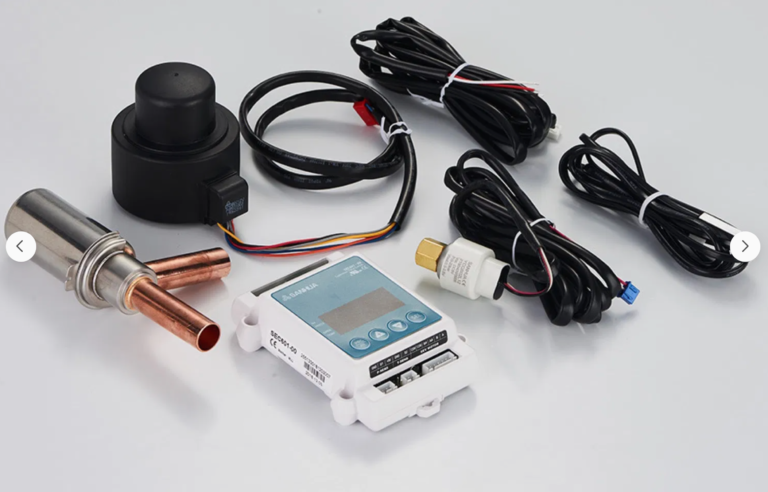
- Sanhua External Equalized TXV (Thermostatic Expansion Valve)
Core Engineering Logic:
Traditional internal equalized TXVs often fail to compensate accurately for pressure drop inside long evaporators.
As thermal load changes, the evaporator outlet superheat becomes unstable.
Realmann solves this using an external equalized TXV, which continuously monitors the actual evaporator outlet pressure and dynamically adjusts refrigerant flow.
The result:
ΔTsuperheat=2K
The evaporator superheat is precisely controlled at approximately 2K.
Why 2K Matters
This ultra-low superheat allows refrigerant to remain in the liquid-to-gas phase change state for the longest possible duration.
That means:
- More evaporator surface participates in heat exchange
- Better refrigeration efficiency
- Faster pull-down performance
- Higher cooling capacity
- Lower energy waste
In simple terms:
Every square centimeter of evaporator surface is fully utilized.
This is the “efficiency extraction” stage of the system.
Stage 2 — The Safety Stage
Building a Compressor Protection Barrier
High efficiency alone is not enough.
An ultra-low 2K evaporator superheat also creates potential liquid return risk during unstable load conditions.
This is where Realmann’s second-stage protection begins.
Core Hardware:
- 500mm Internal Heat Exchange Section (IHX)
- High Thermal Conductivity Aluminum Foil Wrapping
Core Engineering Logic:
The high-pressure liquid line leaving the condenser transfers heat to the low-temperature suction gas returning from the evaporator.
This internal heat exchange performs a secondary vaporization process.
Result:
ΔTtotal superheat=5∼6K
The total suction superheat increases from 2K to 5~6K.
Why This Matters
At 5~6K superheat:
- Residual liquid droplets are completely vaporized
- Compressor suction becomes 100% gaseous refrigerant
- Floodback risk is dramatically reduced
- Compressor reliability improves significantly
This forms the “safety closed loop” of the refrigeration system.
Why 5~6K Is the Golden Ratio in Commercial Refrigeration
In refrigeration engineering, superheat is always a balancing act.
If Superheat Is Too Low
- Liquid slugging risk increases
- Compressor mechanical damage occurs
- Lubrication oil becomes diluted
If Superheat Is Too High
- Suction gas density decreases
- Cooling capacity drops
- Compressor motor overheats
- System COP declines
Realmann engineers optimized the system around the ideal balance point:
5K∼6K
This range achieves:
- Safe compressor operation
- Stable motor cooling
- Full gas-state suction
- High refrigeration efficiency
- Improved system COP
More importantly, the temperature increase comes from internal heat recovery, not wasted energy.
The IHX transforms otherwise unused thermal energy into useful refrigeration cycle optimization.
This is a critical difference between advanced commercial refrigeration systems and conventional designs.
Engineering Challenge: Fitting a 500mm IHX Inside a Compact Refrigeration Cabinet
Adding a 500mm internal heat exchange section sounds simple in theory.
In reality, commercial refrigeration equipment has extremely limited internal space.
Designers must account for:
- Compressor clearance
- Fan airflow
- Condenser layout
- Service access
- Pipe bending radius
- Vibration isolation
- Thermal insulation spacing
Realmann engineers use SolidWorks for full 3D refrigeration system simulation and pipeline optimization.
Through millimeter-level layout engineering, the IHX section is integrated into unused structural spaces while maintaining airflow efficiency and serviceability.
High-conductivity aluminum foil wrapping further improves thermal transfer efficiency between the suction and liquid lines.
This reflects a key engineering philosophy:
Commercial refrigeration reliability is determined by small thermal details.
More Than a Refrigerator — A Professional Production Tool
For commercial kitchens, supermarkets, bakeries, and food factories, refrigeration equipment is not furniture.
It is operational infrastructure.
Benefits for Contractors & Refrigeration Engineers
- Lower warranty claims
- Reduced after-sales service costs
- Higher project reliability
- Stronger technical differentiation
Benefits for End Users
Lower Electricity Costs
Higher system COP directly reduces operational energy consumption.
Longer Compressor Life
Reduced floodback risk significantly extends compressor lifespan.
Lower Food Loss Risk
Stable cooling protects temperature-sensitive products.
Reduced Downtime
Fewer compressor failures mean fewer business interruptions.
Realmann’s Engineering Philosophy
“2K belongs to efficiency. 6K belongs to safety.”
At Realmann, efficiency and longevity are not contradictory goals.
By optimizing every millimeter of the refrigeration cycle, Realmann creates commercial refrigeration systems designed for real-world thermal fluctuations — not laboratory conditions.
From commercial refrigerators and display chillers to bakery showcases, upright freezers, blast chillers, and horeca refrigeration systems, the objective remains the same:
Protect the compressor.
Improve efficiency.
Stabilize the cold chain.
FAQ — Commercial Refrigeration Superheat Control
What causes compressor liquid slugging?
Liquid slugging happens when unevaporated refrigerant returns to the compressor cylinder. Because liquid cannot be compressed, it can mechanically damage compressor components.
What is the ideal superheat for commercial refrigeration systems?
Most commercial refrigeration systems operate best between 5K and 6K total superheat, balancing compressor protection and refrigeration efficiency.
Why use an external equalized TXV?
External equalized TXVs compensate for evaporator pressure drop more accurately, especially in long or complex evaporator circuits.
What does an internal heat exchanger (IHX) do?
An IHX transfers heat between the liquid line and suction line to ensure complete refrigerant vaporization and improve overall system efficiency.
Can lower superheat improve refrigeration performance?
Yes. Lower evaporator superheat increases evaporator utilization and improves cooling efficiency, but it must be balanced with compressor protection strategies.