With the promotion of eco-friendly refrigerants and the elevation and mandatory implementation of energy efficiency standards (GB 26920-2024), the defrosting method carries the highest weight when it comes to commercial kitchen refrigeration equipment achieving Grade 1 energy efficiency. This article will analyze the reasons why hot gas defrosting holds this highest weight.
Direct Energy Consumption vs. Secondary Energy Consumption
To understand the difference, we must first look at the actual power required versus the wasted energy that must be mitigated.
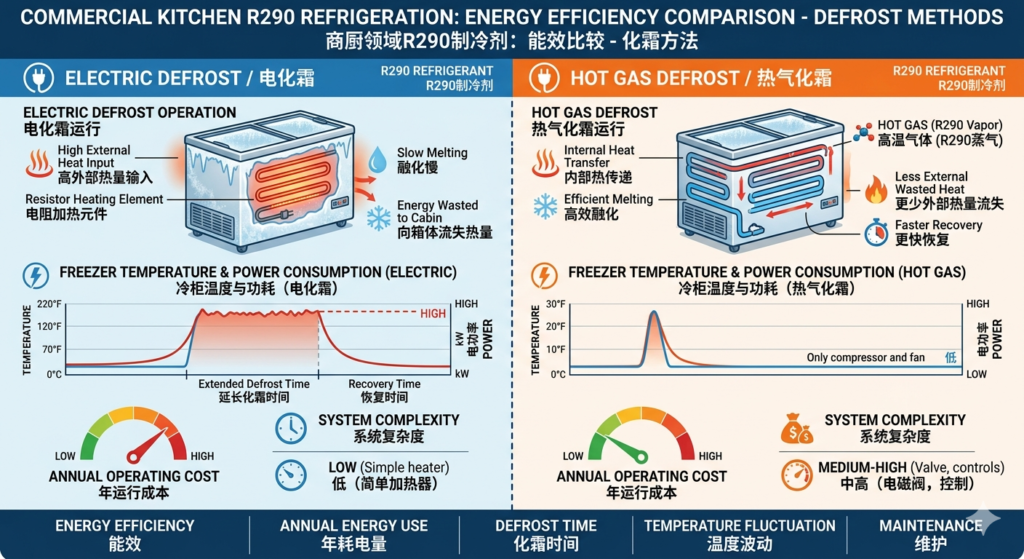
Electric Heating Defrosting
- Heat Transfer Inefficiency: The theoretical efficiency of electrical energy conversion is 100%. However, due to losses through conduction, convection, and radiation, the proportion of heat actually utilized for defrosting is typically only around 35%.
- The Multiplier Effect: Assuming the actual energy required for defrosting is X, the direct energy consumption (DEC) is 2.86X. Out of this, the heat directly wasted and dissipated into the refrigerated space is about 1.86X. To remove this excess heat again using the compressor requires a secondary energy consumption of 0.93X.
- Total Energy Cost: Therefore, the actual total energy consumption of electric heating defrosting is approximately 4 times the actual demand, or 4X.
Hot Gas Defrosting
- Efficient Heat Conduction: In hot gas defrosting, heat conducts from the inside of the pipeline outward. The maximum surface temperature of the copper tube does not exceed 15°C, resulting in relatively low heat loss from convection.
- Negligible Radiation Loss: The acceptable surface temperature of electric defrosting heating tubes used in commercial kitchens is about 320°C (the maximum surface temperature allowed by IEC-60335-2-89 is 370°C). Compared to electric defrosting, the radiation loss in hot gas defrosting is almost negligible.
- Total Energy Cost: Experiments show that the total electrical energy consumed by hot gas defrosting is only about 1.3X.
Summary: The energy consumption of electric heating defrosting is approximately 3 times that of hot gas defrosting.
Refrigeration Energy Consumption
- Temperature Fluctuation: With conventional electric heating defrosting, the maximum temperature of the warmest M-package typically rises by about 4K, whereas with hot gas defrosting, the rise is usually kept within 1K.
- Evaporation Temperature Offset: To achieve the same temperature classification, the evaporation temperature of an electric heating defrosting system must be set about 3K lower than that of a hot gas defrosting system. At evaporation temperatures between -25°C and -28°C, a 3K difference can contribute to a roughly 7.5% difference in overall energy efficiency.
- Conclusion: Therefore, when aiming for the same temperature classification, the energy-saving advantage of hot gas defrosting is significantly more pronounced than that of electric heating defrosting.
Challenges and Future Outlook
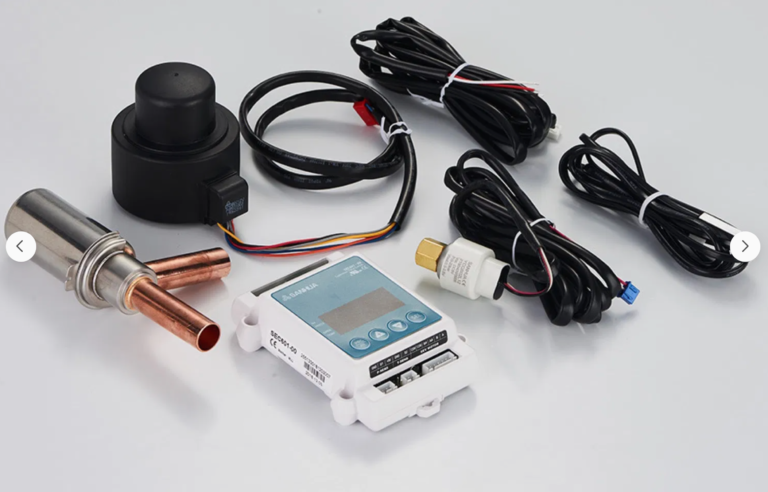
Although hot gas defrosting has clear advantages in energy efficiency, its manufacturing cost is higher than electric heating defrosting. This is due to the necessity of adding supporting accessories, such as:
- Bypass solenoid valves
- Check valves
- Gas-liquid separators
- Pipeline heating accessories
Furthermore, the risk of liquid slugging in the compressor must be rigorously controlled during the design phase. Consequently, the product development cycle and engineering costs are much higher than those for electric heating defrosting. However, the mandatory rollout of the GB 26920-2024 standard has provided a solid foundation for the widespread adoption and popularization of this technology.
Regarding the risk control and assessment of liquid slugging in hot gas defrosting, we will continue the discussion in the next lecture.